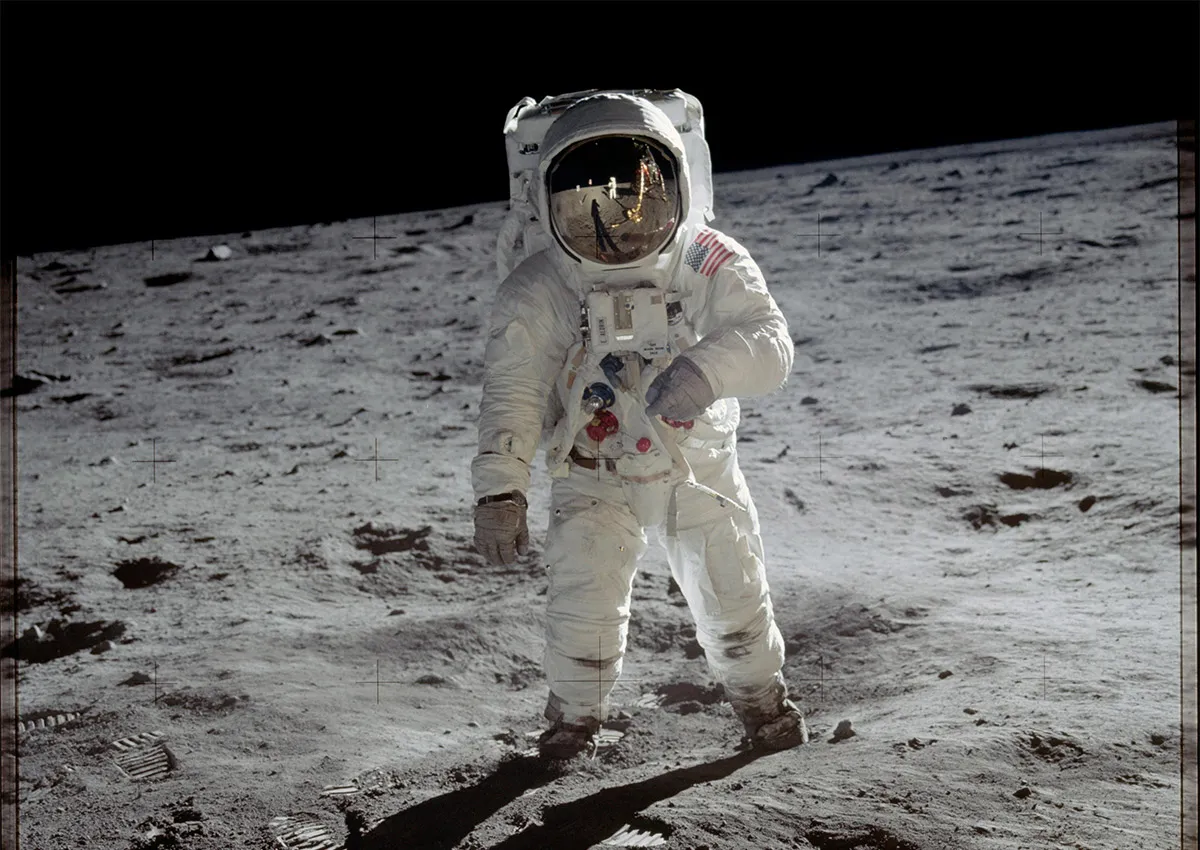
Apollo 11 astronaut Buzz Aldrin on the Moon. Look for Neil Armstrong reflected in Aldrin’s visor. During the following three-and-a-half years, 10 astronauts followed in their footsteps.
Image Credit: NASA
The human story behind our journey to space
We have always looked up.
Long before rockets, satellites and space telescopes, humans stared at the night sky and wondered what was beyond it.
The stars were distant. The planets were unreachable. Space seemed less like a destination and more like a mystery.
Today, we send machines beyond Earth to answer questions that began thousands of years ago.
So why do we keep going?
01 –IT STARTED WITH CURIOSITY
Before humanity could reach space, we first had to understand it.
Ancient civilizations watched the movement of stars and planets. Scientists gradually turned observation into mathematics, and mathematics into our understanding of gravity, motion and the universe.
The desire to understand the sky eventually became something much bigger:
the desire to reach it.
02 –THEN CAME THE ROCKET
From an idea to a machine
A rocket changed everything.
Unlike an aircraft, a rocket doesn’t need the atmosphere to push against. It carries the energy and propellant it needs to generate thrust.
That simple principle allowed humans to turn an impossible idea into a physical journey:
leaving Earth.
The sky stopped being the limit.
03 — THE MOMENT EARTH LETS GO
A launch may last only minutes.
But behind those minutes are years of engineering, testing and preparation.
Then comes ignition.
Engines roar.
Thousands of kilograms begin accelerating upward.
For a brief moment, an enormous amount of science and engineering becomes visible as fire, sound and motion.
A rocket launch is technology becoming reality.
04 — WE DIDN’T STOP AT THE MOON
Once humans reached space, the questions became bigger.
Could we explore other planets?
Could machines operate millions of kilometres away?
Could we see deeper into the universe?
Spacecraft, rovers and telescopes began answering those questions.
Some travelled to other worlds.
Some looked back at Earth.
Others looked billions of years into the past.
* THE BIGGER QUESTION
What are we going to discover next?
We are entering another remarkable period of exploration.
New spacecraft are being developed. Lunar missions are becoming more ambitious. Mars remains a major destination. Powerful telescopes are revealing distant worlds.
But perhaps the most exciting thing about space exploration is that we still don’t know what we will find.
WHY WE LOOK UP
Maybe the answer is simpler than we think.
We explore because we are curious.
We build because we want to understand.
We look beyond Earth because we want to know where we fit in the universe.
Every mission expands the boundary of human knowledge.
Every image gives us a new perspective.
Every launch reminds us that something once considered impossible can become real.
We look up because there is always something beyond what we know.
ONE MINUTE TO REMEMBER
Space isn’t just about going somewhere.
It’s about asking questions.
It’s about building something that has never existed before.
It’s about turning curiosity into technology—and technology into discovery.
Leave a Reply