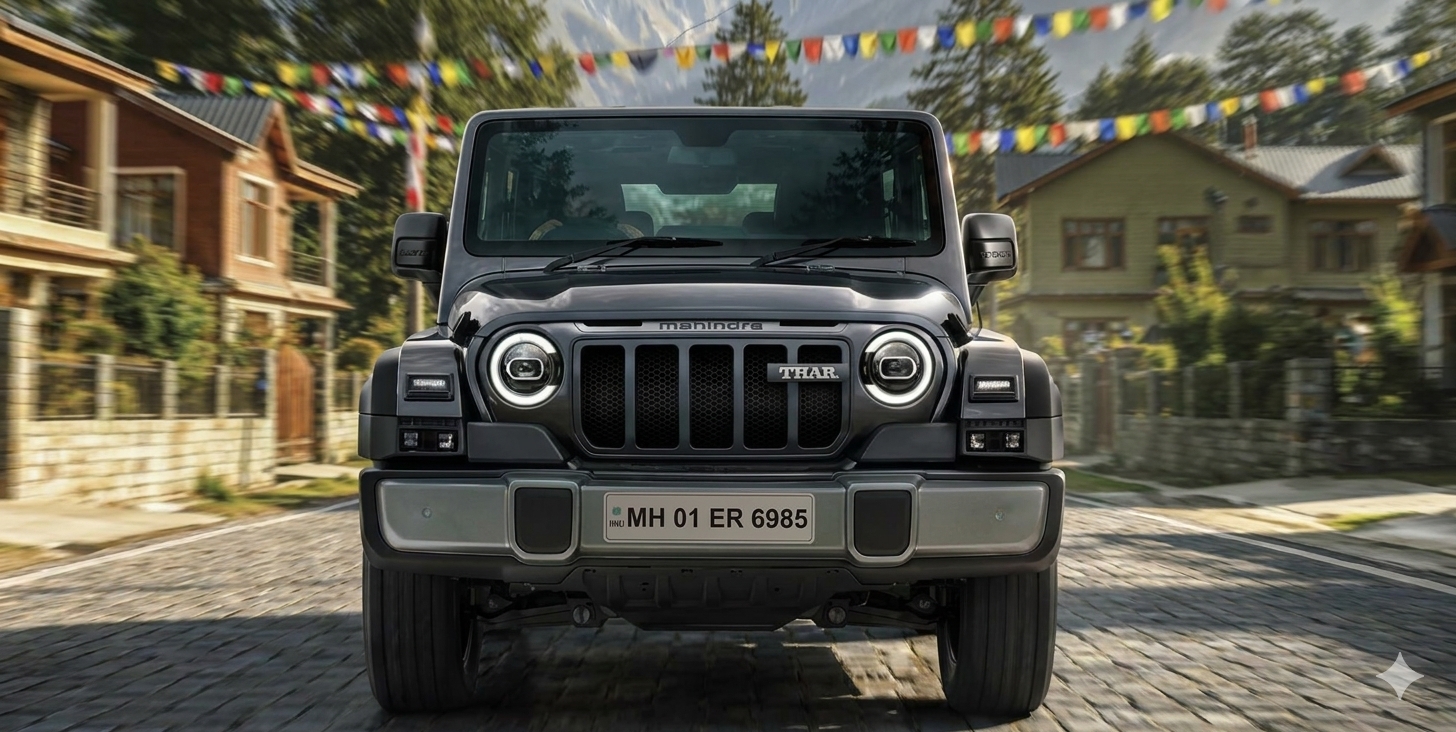
The image is retouched by AI. Credit Mahindra
The iconic three-door Thar gets a new platform, new suspension, more power, electric steering and a serious dose of new technology.
Mahindra hasn’t reinvented the Thar.
Instead, for 2026, it has gone much deeper.
Prices start at ₹10.32 lakh and go up to ₹18.99 lakh ex-showroom, with deliveries beginning October 11, 2026.
So, what actually changed?
Here are 10 upgrades that define the Mahindra Thar OG 2026.
01 — A NEW PLATFORM
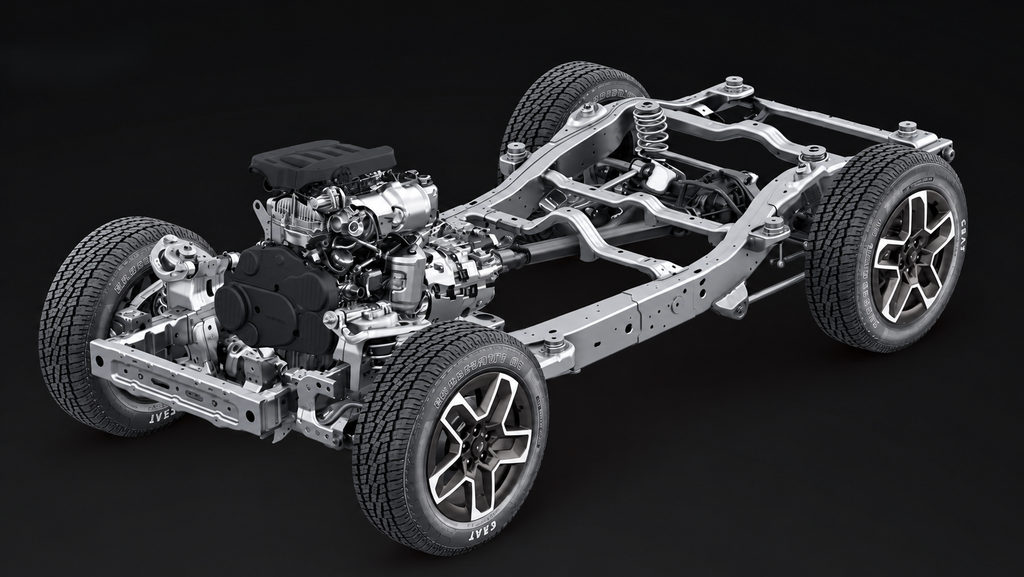
The biggest change is one you can’t see.
The Thar OG moves onto Mahindra’s M_Glyde 4G platform, derived from the architecture used by the larger Thar Roxx.
Mahindra says the new platform provides greater structural stiffness than the outgoing Thar.
That matters because the platform forms the foundation for everything else — suspension, steering, handling and overall body control.
The Thar may look familiar, but underneath, it is substantially different.
What it means:
A stronger foundation gives Mahindra more scope to improve both road manners and off-road capability without changing the Thar’s fundamental character.
02 — THE THAR GETS WIDER
The visual changes are evolutionary rather than revolutionary.
The familiar round headlights remain, but the Thar OG gets:
- New C-shaped LED DRLs
- Full-LED headlamps
- Redesigned grille
- New front bumper
- LED fog lamps on higher variants
- Front parking sensors
- Revised tail lamps
- New Thar OG badging
- Up to 19-inch alloy wheels
The track has also been widened by 50mm, while ground clearance rises to 232mm (6mm↑)
What it means:
The wider stance isn’t purely cosmetic. It works together with the new chassis and suspension to improve stability.
03 — HYDRAULIC STEERING IS GONE
One of the most noticeable changes happens every time you turn the wheel.
The old hydraulic steering system has been replaced by electric power steering (EPS).
That sounds like a technical change.
In everyday driving, however, it is much more obvious.
At low speeds, the steering requires considerably less effort, making parking, U-turns and tight manoeuvres easier. As speed increases, the steering gains weight to provide a more settled feel.
For a vehicle like the Thar, that’s a meaningful upgrade.
What it means:
The Thar becomes easier to live with in everyday traffic without losing its rugged character.
04 — THE REAR SUSPENSION HAS BEEN REWORKED
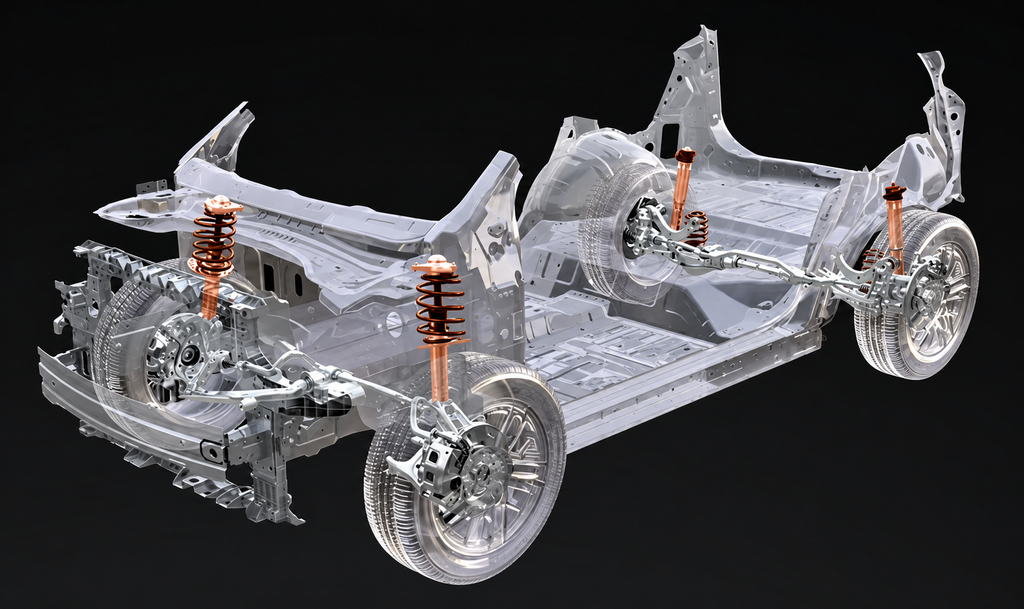
This is where the Thar OG gets seriously interesting.
The rear suspension now uses a PENTALINK setup with a Watts Link, while Mahindra’s DAVINCI damping technology is also introduced.
On the top-spec ZXT, the dampers additionally use Frequency Dependent Damping (FDD).
The Watts Link helps keep the rear axle more controlled laterally, while the revised damping works to reduce the harshness and bouncing associated with rough surfaces.
But the Thar remains a body-on-frame SUV with a short wheelbase.
So this isn’t an attempt to turn it into a soft family crossover.
What it means:
The Thar OG should feel more controlled and comfortable on broken roads while retaining the hardware needed for serious off-road driving.
05 — TWO ENGINES GET MORE POWER
The Thar OG retains its three-engine lineup, but two engines receive substantial upgrades.
2.0-litre turbo-petrol
Old: 152hp / up to 320Nm
New: 162hp / 330Nm
2.2-litre diesel
Old: 132hp / 300Nm
New: 152hp / 330Nm
1.5-litre diesel
Old: 119hp / 300Nm
New: 119hp / 300Nm
The biggest jump comes from the 2.2-litre diesel, which gains around 20hp and 30Nm.
The 1.5-litre diesel remains the unchanged entry-level powertrain.
What it means:
The Thar now has more performance in the petrol and larger diesel versions, particularly useful when climbing, overtaking or tackling difficult terrain.
06 — MORE WAYS TO SEND POWER TO THE WHEELS
The Thar OG continues to offer both RWD and 4WD configurations.
The 1.5-litre diesel remains available as a rear-wheel-drive manual, while the larger petrol and diesel engines offer broader transmission and drivetrain combinations. The 4WD system retains its 2H, 4H and 4L modes.
That means the Thar still has the mechanical hardware expected from a proper off-roader.
But Mahindra has added more electronic assistance around it.
And that brings us to the next upgrade.
07 — AN ELECTRONIC LOCKING DIFFERENTIAL
The Thar OG now gets an electronic locking differential at the rear on 4WD variants.
Why does that matter?
Imagine one rear wheel is sitting on loose mud while the other has better grip.
A conventional open differential can allow the wheel with less resistance to spin.
A locking differential can lock the two wheels together, helping maintain drive when traction gets difficult.
The Thar OG also introduces dedicated Snow, Mud and Sand terrain modes, alongside the normal mode.
What it means:
The Thar’s off-road capability isn’t just about hardware anymore. Electronics now play a larger role in helping the driver use that hardware.
08 — THE CABIN GETS MORE EVERYDAY EQUIPMENT
The Thar’s interior hasn’t been completely redesigned.
The basic dashboard layout remains familiar, including the 10.25-inch touchscreen and analogue instrument cluster.
But there are several useful additions.
Depending on variant, the Thar OG gets features such as:
- Wireless smartphone charging
- Wireless smartphone connectivity
- Rear USB-C charging
- Rear AC vents
- Rear armrests with cupholders
- Boot lighting
- Push-button start
- New leatherette upholstery
- Front parking sensors
- Updated steering wheel
The additions are less about creating a luxury cabin and more about making the Thar easier to use every day.
What it means:
The Thar is becoming less of a weekend toy and more usable as an everyday vehicle.
09 — SAFETY GETS A SERIOUS UPDATE
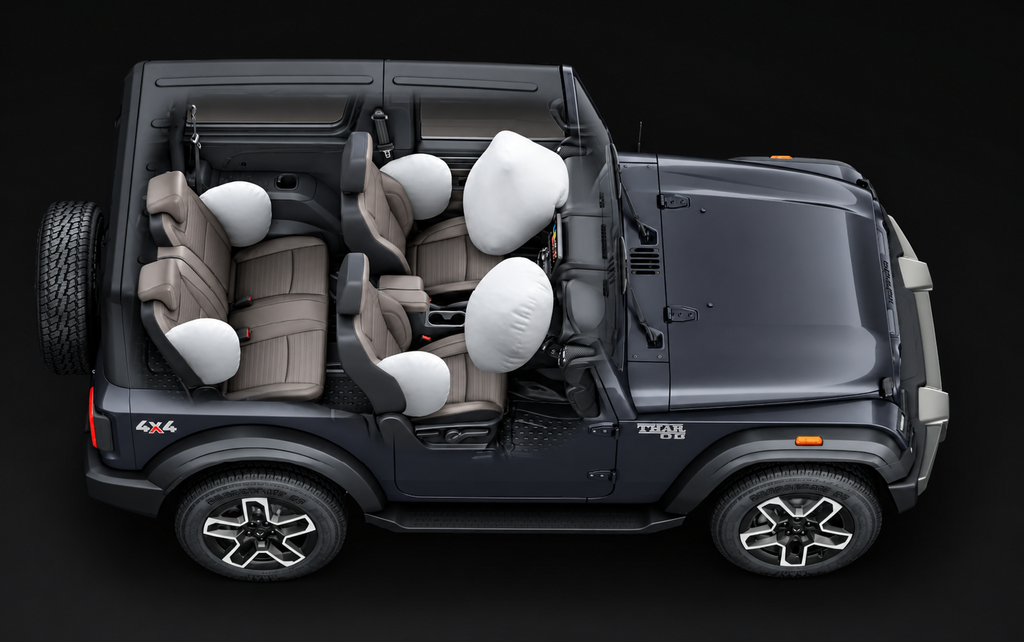
The Thar OG also receives a significant safety upgrade.
Higher variants now offer six airbags, including Mahindra’s HPTS side-airbag system, along with front parking sensors and other electronic safety systems. The top ZXT also gets rear disc brakes.
The electronic stability program has also been retuned, while hill-descent control, TPMS and other systems continue to support the SUV’s off-road role.
What it means:
The Thar’s safety equipment is moving closer to what buyers expect from a modern SUV, rather than simply relying on its rugged construction.
10 — THE PRICE HAS MOVED, BUT SO HAS THE THAR
The Thar OG starts at ₹10.32 lakh ex-showroom and reaches ₹18.99 lakh for the range-topping version.
But the interesting part isn’t simply the price.
Look at what has changed underneath:
| Previous Thar | Thar OG 2026 |
|---|---|
| Previous platform | M_Glyde 4G |
| Hydraulic steering | Electric power steering |
| Previous rear suspension | PENTALINK + Watts Link |
| Conventional damping | DAVINCI + FDD on ZXT |
| 2.0 petrol: 152hp | 2.0 petrol: 162hp |
| 2.2 diesel: 132hp | 2.2 diesel: 152hp |
| 1.5 diesel: 119hp | 1.5 diesel: 119hp |
| Conventional rear traction system | Electronic locking differential |
| No dedicated terrain modes | Snow / Mud / Sand modes |
| Up to 18-inch wheels | Up to 19-inch wheels |
| Earlier safety package | Up to 6 airbags + front sensors |
The important point is that this isn’t simply another cosmetic facelift.
Mahindra has changed the machinery underneath the Thar.
The Thar OG doesn’t change what the Thar is.
It changes how the Thar does it.
Same iconic shape.
New machinery underneath.
That is what makes the 2026 Thar OG more than just another facelift.
MACHINE MINUTE
Machines, made interesting.
Stories from Speed to Light.
Leave a Reply