How Does Something So Heavy as an Airplane Fly?
Four forces. One incredible balancing act.
An aircraft can weigh hundreds of tonnes, yet it can lift off the runway, climb into the sky and cross an ocean.
So what keeps it up there?
It comes down to four forces:
LIFT · WEIGHT · THRUST · DRAG
When they work together, flight happens.
01 ] FIRST, IT NEEDS SPEED
An airplane doesn’t simply jump into the air.
Its engines create thrust, pushing it forward along the runway.
As the aircraft accelerates, air flows faster around its wings.
Eventually, the wings generate enough lift to overcome the aircraft’s weight.
And the wheels leave the ground.
02 ] THE WINGS CREATE LIFT
An aircraft wing isn’t just a flat surface.
Its shape is designed to move through the air and create an aerodynamic force called lift.
As the aircraft moves faster, the wings can generate more lift.
The important idea is simple:

The wing doesn’t make the airplane lighter. It makes the airflow create an upward force.
03 ] FOUR FORCES KEEP THE FLIGHT GOING
Think of an airplane in the sky:
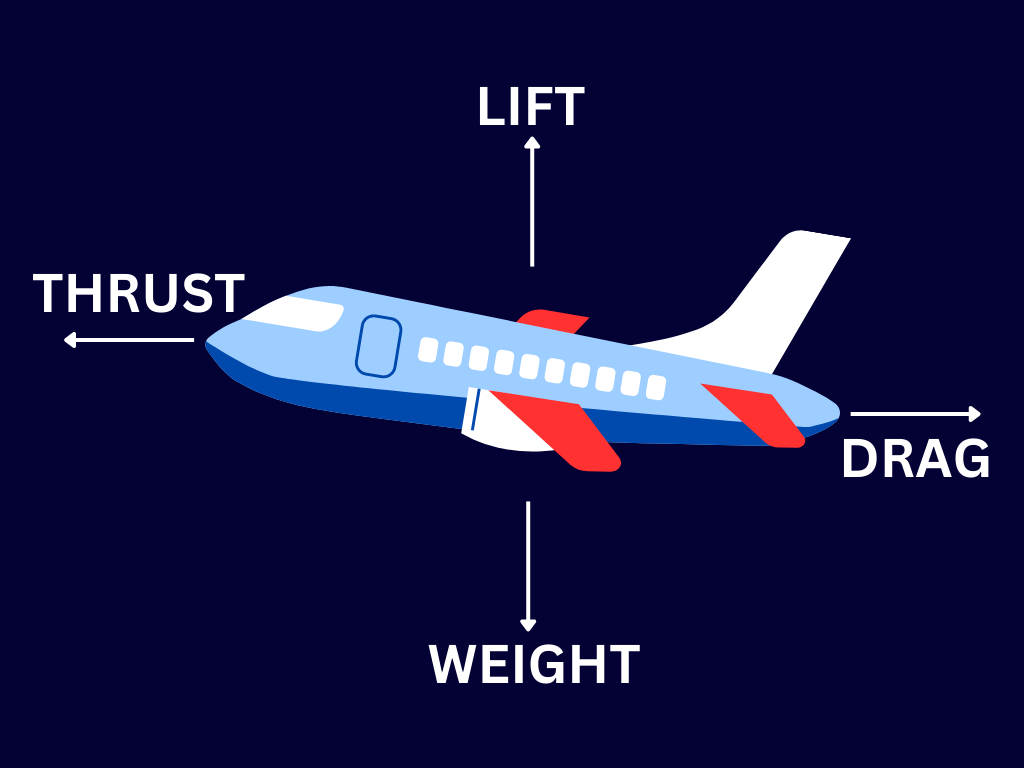
↑ LIFT
Keeps it up.
↓ WEIGHT
Gravity pulls it down.
← THRUST
Moves it forward.
→ DRAG
Resists its movement.
Flight is a constant balance between these forces.
Change one, and the aircraft responds.
04 ] THE ENGINE PROVIDES THE PUSH
A jet engine takes in air, compresses it, mixes it with fuel and burns the mixture.
The resulting high-speed gases produce thrust.
That thrust creates forward movement.
And forward movement allows the wings to generate lift.
Engine → Speed → Lift → Flight
The engine and wings are essentially working as a team.
05 ] FLIGHT IS CONSTANTLY BEING CONTROLLED
An airplane doesn’t simply reach the sky and stay there by itself.
Pilots and flight-control systems constantly manage:
Speed · Altitude · Pitch · Roll · Direction
Modern aircraft use sensors and computers to continuously monitor the aircraft and adjust its flight controls.
What feels effortless from a passenger seat is actually physics and technology working every second.
THE MINUTE
So, how does something so heavy fly?
Thrust moves the aircraft.
The wings generate lift.
Weight pulls it down.
Drag pushes back.
When these forces are carefully balanced, a machine weighing hundreds of tonnes can travel through the sky.
That’s the magic of flight.
The next time you see an airplane overhead, look up.
You’re not just watching a machine fly.
You’re watching physics become motion.
Leave a Reply